



Vietnam Men's Volleyball 2025: Progress Made but Still Insufficient



From late June to December, the men's volleyball team led by head coach Trần Đình Tiền participated in three significant international competitions, spanning from continental to regional levels, which clearly illustrated their current abilities, limitations, and future direction.
The opening tournament for Vietnam's men's team in 2025 was the AVC Challenge Cup, held from June 22 to June 29. This event acts as a clear "level-measuring" platform where mid-tier and developing Asian teams have the chance to compete against each other.
At the AVC Challenge Cup, Vietnam did not cause any surprises, but the tournament revealed distinct gaps in height, jumping ability, and speed compared to many rivals. Weaknesses in blocking and net defense continued to emerge, while a playstyle focused on endurance only helped maintain the game rather than shift momentum against stronger opponents.
Following the AVC Challenge Cup, Coach Trần Đình Tiền's team entered the SEA V-League, an annual Southeast Asian competition, with two consecutive legs in July.
The first leg, held from July 11 to 13 in the Philippines, saw Vietnam struggle with away matches, a tight schedule, and facing fast-paced teams. Given the roster was not fully stable, these games clearly showed a lack of squad depth, especially at crucial moments. Vietnam finished third in this leg.
In the second leg, from July 20 to 23 in Indonesia, Vietnam made some personnel and tactical changes. Though results were not revolutionary, the matches showed a more solid performance, fewer systemic errors, and a more consistent playing rhythm compared to the first leg. Coach Trần Đình Tiền and his players ended this leg as runners-up.
The SEA V-League is gradually becoming a fairly accurate benchmark for Vietnam men's volleyball's status in the region: not yet strong enough to break through, but no longer as inferior as in previous periods.
The men's volleyball team has made significant progress in 2025 but still lacks the quality needed to change their standing in the regional arena. Photo: Minh Hoàng
The tournament concluding Vietnam's men's team year in 2025 was SEA Games 33, held from December 7 to 19 in Thailand. This remains the most crucial competition where results most directly reflect the balance of power in the region.
At the SEA Games, Vietnam failed to produce a performance boost and ended up empty-handed. Close defeats to direct rivals such as Indonesia, Thailand, and even Singapore showed that the gaps in height and defensive organization remain difficult challenges.
However, a positive point was that the team did not collapse, maintaining discipline in their gameplay and minimizing systemic errors.
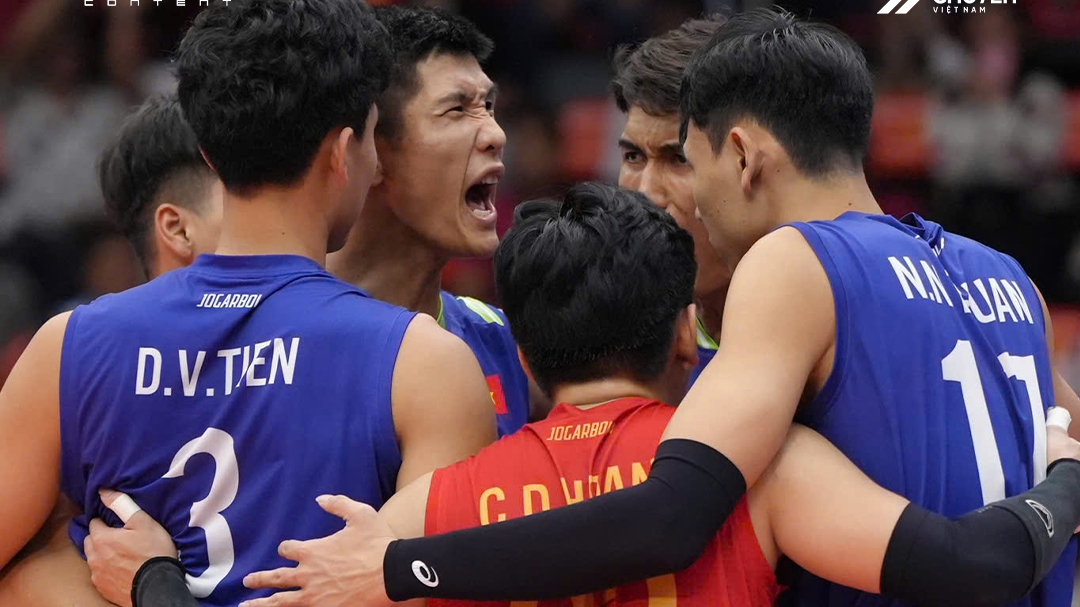
Therefore, SEA Games 33 brought no surprises but marked an important milestone for the coaching staff to comprehensively assess the squad after a year of continuous competition.
Looking back at the three major tournaments in 2025, it is clear that Vietnam's men's volleyball team has played enough and gained enough exposure, but what is still missing is a qualitative transformation. Participation in the AVC Challenge Cup, SEA V-League, and SEA Games has helped the team gain experience, but it is not enough to close the gap with the stronger teams in the region and continent.
Progressing slowly is not the problem, but if the team only focuses on "playing enough tournaments," Vietnam men's volleyball will find it very difficult to make a breakthrough. What is more necessary is a long-term investment strategy, starting with training taller players, improving physical conditioning, and enhancing the quality of the domestic competition environment.

 Links
Links
 Contact
Address:UNIT 1804 SOUTH BANK TOWER, 55 UPPER GROUND,LONDON ENGLAND SE1 9E
Number:+85259695367
E-mali:icecmxtdaf@gmail.com
 App
App


