



Perspective | Male tennis players face a collective points reduction in the new season as ATP ranking system undergoes reform.



The new tennis season began with the United Cup and multiple tours launching, and for numerous male tennis players, the initial change is that some of their ranking points will be removed out of thin air—ATP is reforming the ranking points system from 2026, cutting the number of counted tournaments from 19 to 18.

Image: Li Jianyi
The 18 tournaments counted towards ranking points still include the four Grand Slams and eight mandatory ATP 1000 Masters events; if a player qualifies for the ATP Finals, it counts as an additional event in their points tally. The change lies in that only the six best results from other tournaments will now be counted, and for the top 30 players, the required number of ATP 500 events to participate in this season has dropped from five last year to four.
This adjustment took effect in the first week of the new season. Among the top 10 players, only Alcaraz, Sinner, and Draper were unaffected; the other seven players saw a slight drop in points due to the removal of one best counted tournament from their rankings, though this reduction did not disrupt the standings among the elite group.
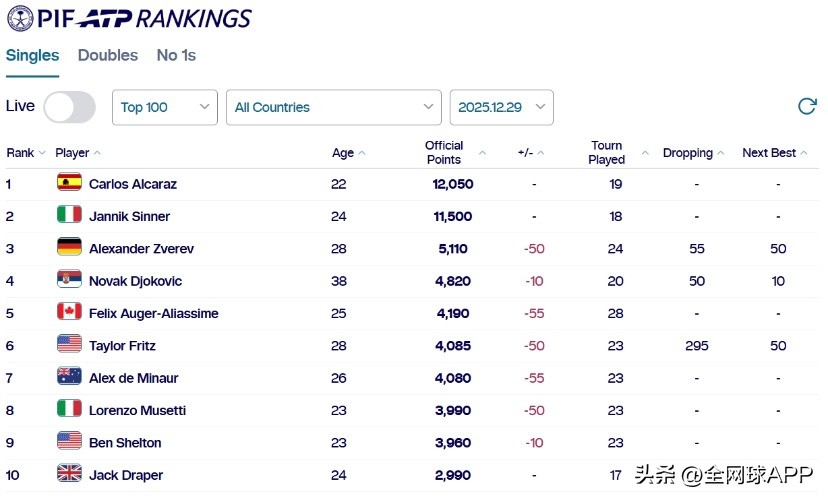
-55 points: Aliassime (No.5), Deminor (No.7)
-50 points: Zverev (No.3), Fritz (No.6), Musetti (No.8)
-10 points: Djokovic (No.4), Shelton (No.9)
Expanding the scope, the impact of the rule changes becomes more pronounced further down the rankings. Within the top 30, Lehecka and Khachanov swapped places, as did Darderi and Griekspoor. Changes outside the top 30 could directly affect seedings for the 2026 Australian Open: Munar rose three spots to No.33, Moutet climbed one to No.34; Brandon Nakashima and Tsitsipas each dropped two places, now at No.35 and No.36 respectively. For Tsitsipas to secure a seeded spot at the Australian Open, he must perform strongly in the United Cup this week.
In recent years, discussions about the overly congested tennis calendar have intensified. Top players in their prime such as Sinner, Alcaraz, Sabalenka, and Swiatek have expressed concerns. Many players face a dilemma between improving their rankings and protecting their bodies due to fatigue and injuries caused by frequent competition.
Both ATP and WTA tours span five continents over more than eleven months annually, with a packed schedule. Mandatory Grand Slams, ATP 1000 level tournaments, optional tours, and lower-tier challengers pile up, alongside team events like the Davis Cup, Billie Jean King Cup, and United Cup, leaving players with very limited time for rest and training.
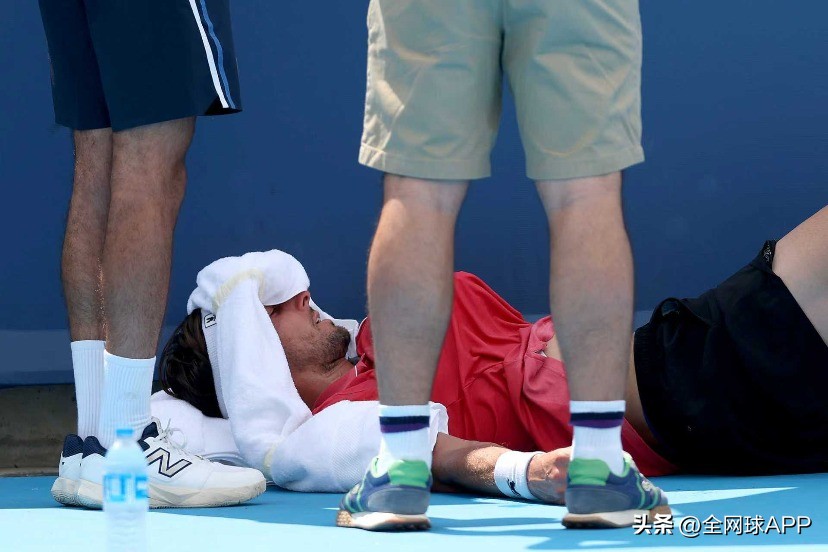
Medvedev overwhelmed by heat at the Cincinnati Masters. Image: Visual China
Last March, the Professional Tennis Players Association (PTPA) filed a lawsuit against tennis governing bodies including ATP, WTA, ITF, and ITIA, accusing them of anti-competitive practices and blatant disregard for players’ rights. The 163-page complaint detailed grievances such as restrictions on prize money and authoritarian ranking systems that force players to participate in specific tournaments to maintain their careers, resulting in near year-round schedules that compel players to compete in extreme heat or at odd hours.
In response, both ATP and WTA strongly denied the PTPA’s allegations and vowed to defend their positions. However, the case ultimately ended in favor of the PTPA, possibly prompting the ATP and WTA to introduce several reforms this year.
Besides reducing the number of tournaments counted for rankings, at the end of last season ATP also implemented measures to address extreme heat during events, protect personnel involved in the tour, and investigate and penalize misconduct. This year, ATP plans to launch specialized training for players, coaches, and staff, aiming to enhance protection of all parties’ rights within the tour.
(Written and edited by: Dato)

 Links
Links
 Contact
Address:UNIT 1804 SOUTH BANK TOWER, 55 UPPER GROUND,LONDON ENGLAND SE1 9E
Number:+85259695367
E-mali:icecmxtdaf@gmail.com
 App
App


