



China U23 National Team: Focus on practicing the “532” formation, aiming to secure points in the first two matches to advance



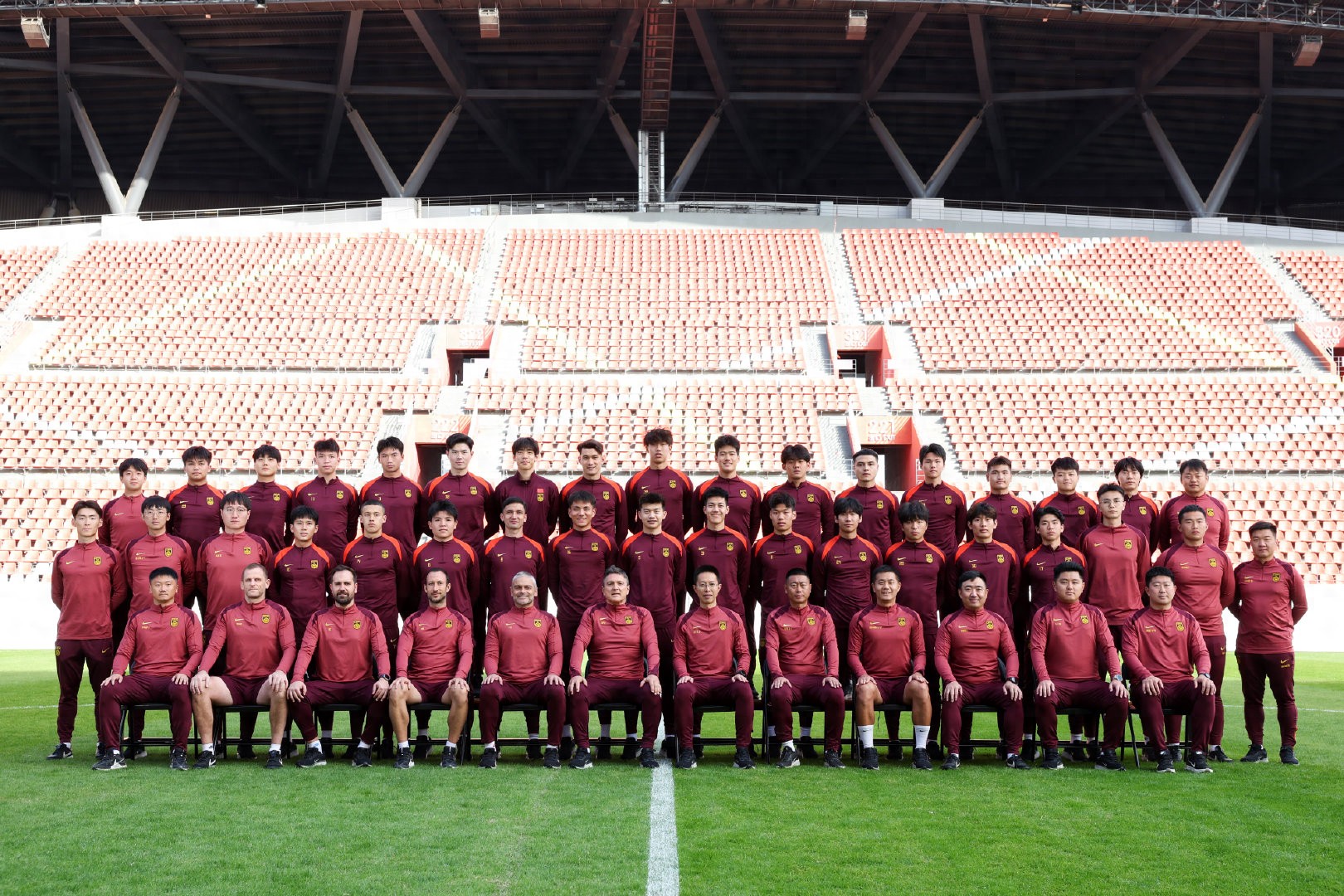
Reporter Lu Mi reports The 2026 U23 Asian Cup is set to begin on January 7 in Saudi Arabia, representing the first official competition for China’s men’s national teams across all age groups in 2026. Following their overseas training in Dubai, the China U23 team traveled to Riyadh on January 3 to commence the last phase of their tournament preparation, with the squad actively gearing up for the demanding group matches.
Emphasis on practicing the 532 formation
The U23 national team’s preparation started in full swing last December, gathering in Zhaoqing on December 7 and entering a fully closed training camp after arriving in Dubai on December 18 to refine their tactical system. Originally, four friendly matches were planned, but due to issues from Kyrgyzstan’s side, only one of the two scheduled games against Kyrgyzstan U23 was played. During the Dubai training phase, the team had only one friendly match on January 1 against Iran U23. Although China dominated possession at 55% and created more scoring chances, a defensive clearance error led to an own goal, resulting in a narrow 0-1 loss. Prior to this, the U23 team had won 4-0 against Hong Kong U23 and 1-0 against Kyrgyzstan U23 in friendlies. The Dubai training ended with a record of two wins and one loss, showing solid tactical execution but also revealing a lack of finishing ability upfront.
Regarding personnel, the initial training roster included 29 players from key clubs such as Shanghai Port, Shandong Taishan, and Zhejiang, featuring standout performers like Wang Yudong, Bai Helamu, and emerging talents from the U20 Asian Cup like Kuai Jiwen and Peng Xiao. Notably, Wang Bohao, who plays for the Dutch club Den Bosch, was selected, bringing valuable overseas league experience. This 20-year-old has appeared over 10 times in the Dutch second division, capable of starting matches and playing full games while contributing assists. His time abroad has enhanced his physicality and tactical awareness, injecting fresh energy into the midfield.
Before moving to Saudi Arabia, the coaching staff finalized a 23-player squad, with midfielder Yimulan excluded due to limited playing time in friendlies. Alongside him, three other players—Yao Haoyang from Chongqing Tongliang Long, Zhang Yixuan from Qingdao Red Lions, and Zhu Pengyu from Dalian Yingbo—were also left out. The final 23 combine experienced Chinese Super League mainstays with promising young talents, forming a lineup balanced in both experience and vigor, which is essential for the team’s goal of advancing from the group stage.
Head coach Antonio previously led the team through the U23 Asian Cup qualifiers, securing a spot in the final round as group runners-up with notable wins including 2-1 over Timor-Leste and a 10-0 thrashing of the Northern Mariana Islands. During preparation, Antonio focused on practicing the 532 defensive counterattack formation tailored to the group opponents. This approach proved effective in the friendly against Kyrgyzstan, though based on prior qualifiers, Antonio is unlikely to rely exclusively on the 532 system.
Aiming to secure points in the first two matches
This edition of the U23 Asian Cup is divided into four groups and will take place from January 7 to 25, 2026, in Saudi Arabia. The U23 national team is placed in Group D, with their first match against Iraq U23 on January 8, followed by Australia U23 on January 11, and Thailand U23 on January 14. All three games will be held in Riyadh.
Although Iraq’s strength is weakened due to several overseas players being unavailable, they are buoyed by recently finishing as runners-up in the Gulf Cup, showing strong physicality and disciplined tactics. The outcome of the opening match will directly impact the group’s qualification dynamics. Australia U23 has undergone major squad changes, retaining only 11 players from the qualifiers and adding strong forwards like Jovanovic, making them stronger than before. China drew 0-0 with them in the qualifiers, so both sides are familiar with each other’s tactics. Thailand fields many U21 players and is comparatively weaker overall. To qualify, China’s U23 team must secure all three points against Thailand and strive to earn points against Iraq and Australia.
Looking back at China’s history in the men’s U23 Asian Cup, the team has only won two matches in 2018 and 2024, losing the other 13 games, making group stage qualification a critical breakthrough target. For this squad, the tournament represents both a challenge and an opportunity: Iraq’s incomplete lineup is a potential advantage; Australia has major roster changes; Thailand is relatively weaker. If the U23 team can earn points in the first two key matches, they will control their path to qualification. Having gained experience from multiple major competitions in recent years, the team’s mentality is more mature compared to their U20 Asian Cup days.
The U23 team rested on January 2 and then fully committed to the final preparation phase. Coach Antonio will focus on improving finishing in attack and reducing unnecessary defensive errors, while further refining set-piece tactics to strive for a breakthrough in the group stage.
The detailed 23-player roster for China’s U23 Asian Cup team is as follows↓
Goalkeepers: 1 - Luan Yi (Shijiazhuang Kungfu), 12 - Huo Shenping (Zhejiang), 16 - Li Hao (Qingdao West Coast);
Defenders: 2 - Hu Hetao (Chengdu Rongcheng), 3 - He Yiran (Changchun Yatai), 4 - Wumiti Jiang Yusupu (Shanghai Port), 5 - Liu Haofan (Zhejiang), 15 - Peng Xiao (Shandong Taishan), 17 - Bao Shimeng (Suzhou Dongwu), 19 - Zhang Aihui (Zhejiang), 23 - Yang Xi (Qingdao West Coast);
Midfielders: 6 - Xu Bin (Qingdao West Coast), 13 - Wang Bohao (Den Bosch, Netherlands), 14 - Yang Haoyu (Shanghai Shenhua), 21 - Bao Shengxin (Zhejiang), 18 - Chen Zeshi (Shandong Taishan), 20 - Li Zhenquan (Chongqing Tongliang Long);
Forwards: 7 - Xiang Yuwang (Chongqing Tongliang Long), 8 - Mutalifu (Qingdao West Coast), 9 - Bai Helamu (Shenzhen New Pengcheng), 10 - Wang Yudong (Zhejiang), 11 - Kuai Jiwen (Shanghai Port), 22 - Mao Weijie (Dalian Yingbo).


Wonderfulshortvideo
Class personified.


chelsea 3-3 leeds united 4-1 wolves
yamal getting better raphinha goals today raphinha vs osasuna yamal barcelona highlights yamal pass today
marc bernal highlights bernal barcelona vs frankfurt yamal goal today yamal highlights today lewandowski goal ferran goal raphinha goal barcelona champions league
jamie carragher salah interview monday night football carragher mnf salah press conference salah benched slot interview slot press conference
Griezmann with the cool finish 🥶
kounde goals today yamal assist today rashford assist today barcelona 2-1 frankfurt
 Links
Links
 Contact
Address:UNIT 1804 SOUTH BANK TOWER, 55 UPPER GROUND,LONDON ENGLAND SE1 9E
Number:+85259695367
E-mali:icecmxtdaf@gmail.com
 App
App


