



The Spider Man reaches 100 clean sheets in the Premier League



In a goalless match, the “Spider Man” quietly achieved the milestone of 100 clean sheets, marking a special record in the Premier League.
The 0-0 draw against Leeds United at Anfield didn’t bring Liverpool’s usual goal fest, but it did signify an important milestone. Alisson Becker officially reached 100 clean sheets in the Premier League for the “Red Brigade,” a feat that clearly reflects the Brazilian goalkeeper’s consistency and high level of performance over multiple seasons.
This milestone wasn’t achieved through flashy moments but through perseverance. Alisson became the fifth Liverpool goalkeeper in history’s top flight to reach 100 clean sheets. Before him were legendary names like Ray Clemence, Bruce Grobbelaar, Pepe Reina, and Elisha Scott, who shaped the club’s defensive identity across generations.
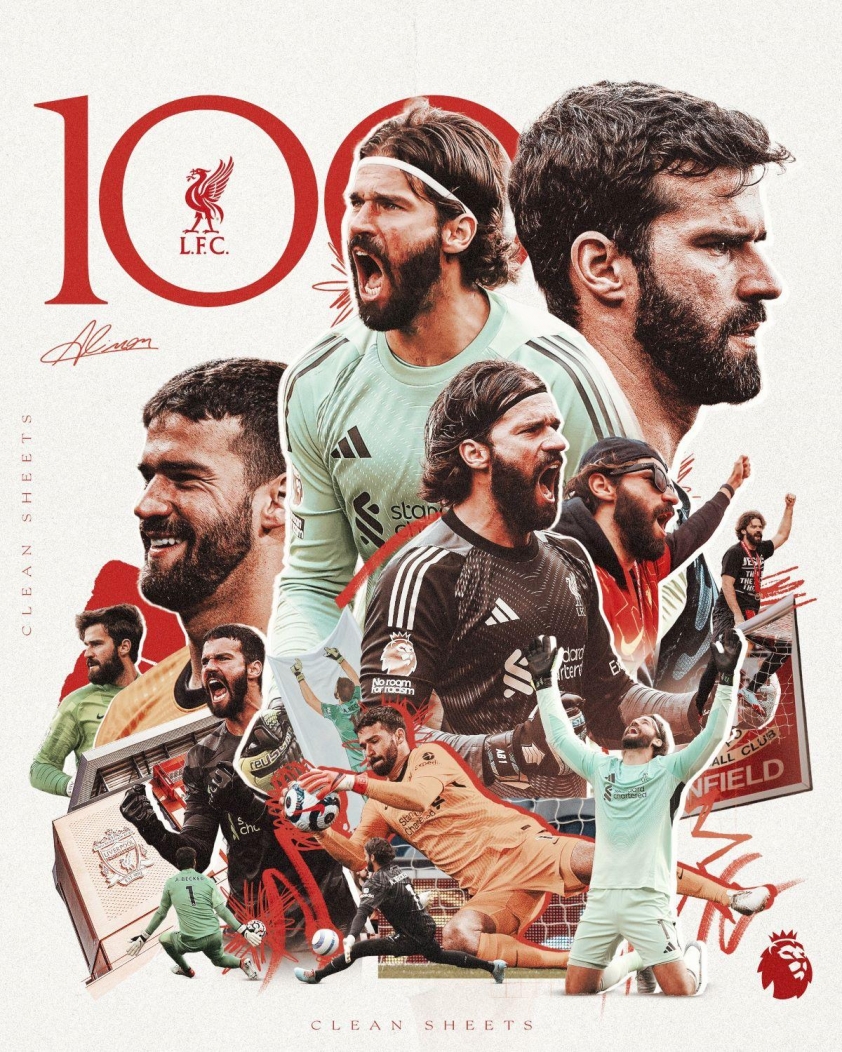
Notably, Alisson reached this achievement amid the increasing difficulty of the Premier League. Modern football demands goalkeepers not only to save shots but also to contribute to build-up play. At Liverpool, Alisson often has to push forward, play with his feet, and face one-on-one situations as the defense presses aggressively.
Alisson’s reliability helps Liverpool maintain tactical balance. Even when the attack occasionally lacks spark, his clean sheets provide the foundation for the team to control matches. Many times, a single crucial save by Alisson is enough for Liverpool to preserve points and keep up their competitive rhythm domestically.

Historically, Alisson’s numbers gain even more significance when compared with the legends. Ray Clemence leads with 226 clean sheets, followed by Grobbelaar with 184, Reina with 134, and Scott with 125. Alisson’s inclusion in this list shows he has risen to the ranks of the greatest goalkeepers at Anfield.
At present, the 100-match milestone is not an endpoint but a stepping stone. With his fitness, form, and irreplaceable role, Alisson is expected to continue improving his record. For Liverpool fans, his clean sheets are the cornerstone of the team’s ambition and long-term stability.



Wonderfulshortvideo
The footwork, the finish 🤌


The Wirtz x Sané link-up 🔗
Class personified.
yamal getting better raphinha goals today raphinha vs osasuna yamal barcelona highlights yamal pass today
Griezmann with the cool finish 🥶
“afcon funny moments”
🤤🤤
 Links
Links
 Contact
Address:UNIT 1804 SOUTH BANK TOWER, 55 UPPER GROUND,LONDON ENGLAND SE1 9E
Number:+85259695367
E-mali:icecmxtdaf@gmail.com
 App
App


