



Summer window strategic mistakes triggered chaos; Liverpool’s management must take action



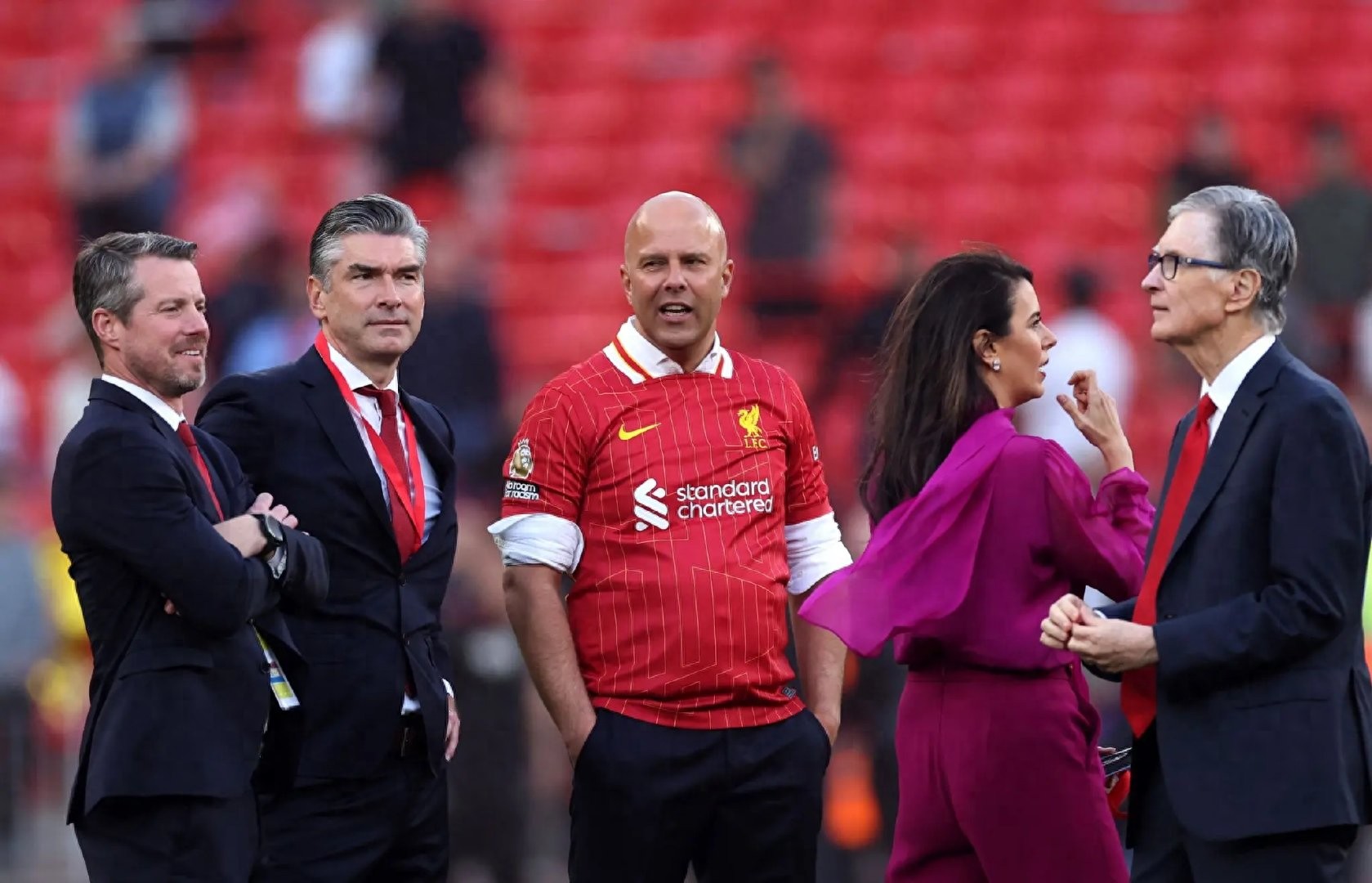
Written by Han Bing Last Saturday at Anfield, Salah, coming off the bench to assist and almost score, made a solo lap after the game to thank supporters as a farewell before the Africa Cup. His earlier discussion with Klopp signified a “truce,” and now he seeks to regain the fans’ confidence. However, the crisis is far from over; this is not merely a personal dispute between Salah and the coach but a “comprehensive crisis” for Liverpool Football Club.
Sporting director Hughes was involved in the decision to exclude Salah from the Champions League squad, and last week he maintained communication with Salah’s agent Abbas. Liverpool’s upper management conveys that they still want Salah to stay. If the conflict becomes irreconcilable, the club will make swift decisions just like they did when renewing Salah’s contract in April. The Salah crisis is temporarily on hold due to the Africa Cup, but Liverpool’s leadership has reached a critical point where they must intervene to resolve the issue.
Fenway’s strategic crisis
Salah’s outburst a week ago directly pointed to internal issues within Liverpool, implying that more people are involved in locker room decisions. Soon after, Klopp revealed that sporting director Hughes had a hand in excluding Salah from the Champions League squad against Inter Milan. The English media views the Salah crisis as a strategic problem for the Fenway Group: renewing Salah’s contract at the end of last season sharply contrasts with this summer’s recruitment strategy designed for a post-Salah era. If a full overhaul of the attack was decided, why offer a high-paying new contract to 33-year-old Salah? This contradicts Liverpool’s recent data-driven transfer strategy.
Sporting director Hughes represents the club, while Edwards stands for the higher-level Fenway Group. The core issue in the Salah crisis is that the strategy designed by Liverpool’s leadership over the past eight months has flaws. First, the timely and effective renewal of contracts for three key players expiring this summer has been strongly questioned. Second, Liverpool’s €480 million investment this summer shows an attempt to make comprehensive short-term changes. Yet, retaining Salah with a high salary while heavily investing for a future without him inevitably causes tactical and locker room conflicts.
English media urges Hughes and Edwards not to remain silent but to actively intervene to resolve the crisis. It has become clear that the summer overhaul led by them was too radical. Players like Diaz, Arnold, Nunez, Tsimikas, Kelleher, and Konate, who played over 1000 minutes last season, have left, including important rotational young player Elliott. Meanwhile, only three defenders were signed, and after the failed pursuit of Guehi and Leonie’s injury, Liverpool’s defense collapsed early in the season.
An even more severe transformation in team dynamics is that after Elliott’s departure, Salah is the only left-footed forward on the squad. The team lacks even a left-footed midfielder or center-back, making balanced attack and defense impossible. Diaz’s exit left Gakpo as the sole option on the left wing, weakening midfield as well. Wirtz, unfamiliar with the left No. 10 role from his Leverkusen days, must adapt to the central No. 10 position in Klopp’s 4-2-3-1 system. All these changes have caused chain reactions in the team’s offense and defense, altering the midfield and forward ecology and changing player demands. Most roles from last season’s championship starting lineup have shifted, with Salah becoming the biggest casualty.
Since Klopp is essentially a coach rather than a traditional British-style manager at Liverpool, resolving the Salah crisis requires higher-level intervention. The urgent matter is deciding whether Salah stays or leaves.
Full intervention with dual plans
English media believes Salah’s “blast” was orchestrated by his agent Abbas. Salah is his sole “client,” and he needs to ensure this Arab football “global icon” receives due respect and treatment. Salah’s sudden appearance in the mixed zone for a confrontational interview a week ago was clearly deliberate. Liverpool legend Carragher criticized Salah’s “arrogance” and “conceit,” stating it was obviously planned by Abbas. Abbas wants to create the impression that he and Salah are fighting against the injustices imposed on them by Liverpool.
Liverpool’s top management has begun full involvement; besides Klopp, sporting director Hughes maintains close contact with Abbas. During the Africa Cup, Hughes will continue discussions with Abbas.
Liverpool hopes to retain Salah at least until the end of this season. Although Salah, earning £400,000 a week, has temporarily struggled with tactical changes, his performance off the bench at Anfield last Saturday clearly improved, proving the tactical conflicts are not irreconcilable.
After the Salah crisis erupted, most Liverpool players supported Klopp but also understood the Egyptian star’s reaction. The club urged players to avoid causing additional problems, emphasizing unity as the foundation for resolving the crisis. The various post-win displays at Anfield last Saturday were part of crisis management. The widely circulated “farewell ceremony” on social media never happened; no club would hold such a ceremony for a player they are still trying to keep. Even if Salah’s departure becomes inevitable, the primary negotiation principle is not to reveal the true bottom price to buyers: a farewell ceremony would signal the player’s exit is certain and reduce the transfer fee.
Liverpool’s management also holds a trump card in Salah’s family life: the Egyptian star’s 11-year-old daughter is about to start middle school. Leaving a comfortable lifestyle and familiar social circles would greatly impact Salah’s family. Professionally and personally, this is not a change that can be made lightly.
However, Liverpool’s leadership has prepared two plans: besides Klopp continuing to adjust the starting lineup without Salah, Bournemouth’s Ghanaian winger Semenyo has been identified as the top candidate to replace Salah. The 25-year-old Semenyo is fast and capable of playing on both wings. This season, he has appeared 14 times in the Premier League, scoring 6 goals and providing 3 assists, outperforming Salah’s offensive stats. His £65 million release clause can be activated this winter, allowing Liverpool to act at any time. The only concern is that Semenyo’s last goal contribution was in early October, and he has no goals or assists in the last eight Premier League matches. Whether to sign him requires further observation.


Wonderfulshortvideo
CR7 was really going through it 🤣🏆


 Links
Links
 Contact
Address:UNIT 1804 SOUTH BANK TOWER, 55 UPPER GROUND,LONDON ENGLAND SE1 9E
Number:+85259695367
E-mali:icecmxtdaf@gmail.com
 App
App


